To make ChatGPT write a long story, don't ask for it in one message. Ask for an outline first, then one chapter per message, each well under 2,000 words, and paste a short summary of the story so far back in whenever the chat gets long. No setting makes it write more; OpenAI's help centre says so in as many words: "There is no 'minimum tokens' setting. If you need a minimum length, specify it in your prompt." The method works, but a 30,000-word story comes to two dozen or more messages you type and a summary you keep up by hand.
The other way, new on 18 November 2026, skips the prompting: KudoNovel's Autopilot writes the story on by itself, three paragraphs at a time, while you read.
Why ChatGPT writes a short story when you ask for a long one
You ask for a 10,000-word story and get 1,500 words that rush to an ending. The cause sits in how these models were trained, and no wording of the prompt fully gets around it.
- They learned on short answers. Yushi Bai and co-authors reported in LongWriter (August 2024) that models able to read 100,000 tokens "struggle to generate outputs exceeding even a modest length of 2,000 words", because the examples they were tuned on were that short.
- Long length targets fail. LIFEBench (May 2025) gave 26 models instructions from 16 to 8,192 words and found they follow short ones but "deteriorate sharply beyond a certain threshold"; almost all fell short of the maximum output their makers claim. The paper's own example of the hard case is "write a 10,000-word novel".
- The complaint is years old. On OpenAI's forum in November 2023, someone wanted "a long bedtime story like around 3000 words long" and couldn't get it. In April 2025 another post described asking for a "1000-page novel" and getting a single line back, with the task treated as done.
- Nothing is written between your messages. In July 2025 PC Gamer reported on a Reddit user who spent 16 days believing ChatGPT was building a 700-page illustrated book. The article's subhead: "There was no book." ChatGPT only writes while it's answering you.
How much of your story ChatGPT can keep in view, plan by plan
A long story in one chat runs into the chat's window: everything ChatGPT can see at once, your prompts and its replies together.
| ChatGPT plan | Instant window | About this many words of chat | Reasoning window | About this many words |
|---|---|---|---|---|
| Free | 27K tokens | 20,000 | "Varies" | not stated |
| Go | 54K tokens | 40,000 | 256K tokens | 190,000 |
| Plus ($20 a month) | 54K tokens | 40,000 | 256K tokens | 190,000 |
| Pro | 128K tokens | 96,000 | 400K tokens | 300,000 |
Source: ChatGPT's pricing page, read 18 November 2026; Plus's price from OpenAI's help centre the same day. Words worked out by us at OpenAI's own rate, "100 tokens are approximately 75 words".
Those word counts are the most a chat can hold, and your story gets less. OpenAI's pricing page says the share for you is smaller than the total, because the window also carries "system instructions (including tools and personality), memories (if enabled), and internal processing". Every "make it darker" and every rejected draft takes room too. On ChatGPT Free, a 20,000-word novella with its prompts fills the window, and chapter one starts dropping out of what ChatGPT sees. Picking a reasoning model buys a far bigger window on Go, Plus and Pro, within each plan's usage limits for those models.
How to make ChatGPT write a long story: six steps
- Get the outline first. Premise, the cast with names and ages, and a numbered list of chapters with what happens in each. Keep a copy outside the chat.
- One chapter per message. "Write chapter 3: Mara finds the second ledger and hides it from Jonah. About 1,500 words. End when she hears his car. Don't wrap up the story." A word target under 2,000, an event and a stopping point give it something it can hit.
- Say what it must not do. No skipping ahead to later chapters, no closing moral, no new characters. Three short lines, and they name the exact habits that rush a story to its end. For a slow burn, add where the next kiss is allowed to happen; how to write a slow burn romance has the pacing.
- If a chapter stops short, ask it to continue from the last sentence, in the same scene and toward the same stopping point.
- Keep the summary yourself. At the end of each chapter request, ask for a 200-word summary of the story so far and a list of who knows what. Paste both at the top of the next request. In a ChatGPT Project you can keep the outline and summary as project files, which OpenAI says chats in the project can use as context, but you still update the summary file yourself. When a chat nears its window (the table above), open a new one with the outline, the summary and the last page.
- Check each chapter before the next. Names, ages, injuries, who's in the room, and the stock phrases that creep in by chapter five (40 words AI overuses in fiction is the list). A slip you let through gets copied forward.
The fuller version of steps 5 and 6, what to put in the summary and how to choose the page you paste, is in how to get AI to continue your story.
How to make ChatGPT write longer chapters
Ask for one scene per message, each with its own event and stopping point, then join them into the chapter. A 4,000-word chapter asked for in one message is exactly the case LIFEBench measured falling short. Developers calling OpenAI's API get a "verbosity" setting, but OpenAI says it "influences detail level but not hard limits".
The prompt count: a 30,000-word story in ChatGPT
Here's what the method above costs for a novella, at 1,500 words a chapter:
| What you do | Messages you type |
|---|---|
| Ask for the outline, then adjust it | 2 |
| Ask for each of 20 chapters, with the summary and "who knows what" at the end, the last summary pasted in | 20 |
| Ask it to continue when a chapter stops short | a few |
| Start a new chat with outline, summary and last page when the window fills (Free: about every 20,000 words of chat) | 1 or more |
| Total, before a single rewrite | about 25 |
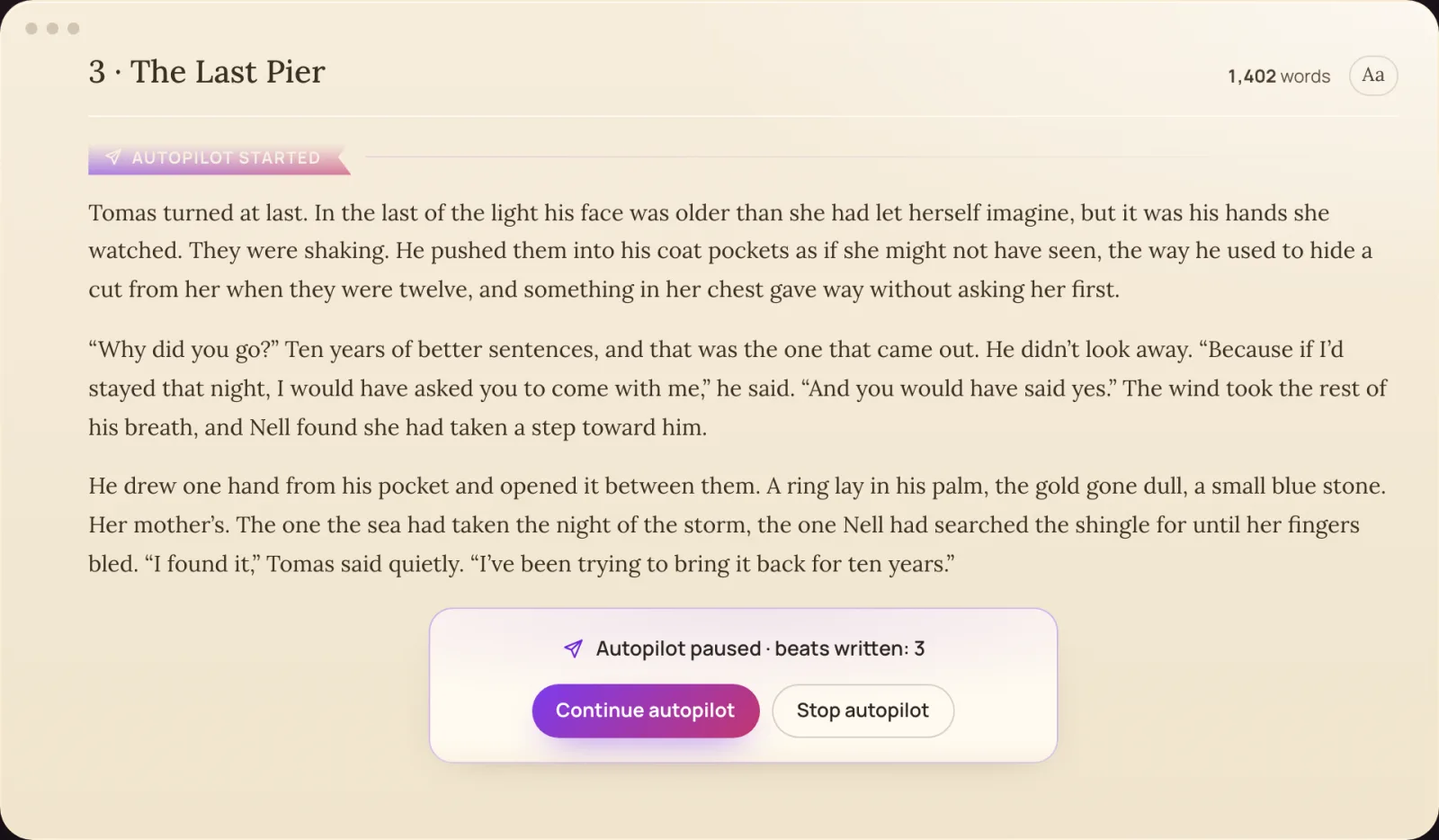
Every one of those is typed, and most carry a pasted summary. Autopilot counts differently, in beats, and a beat is one paragraph, so this is not words for words: thirty beats is Start once, Continue nine times, and four new directions to confirm or change, one every six beats. None of those presses asks you to type anything after your opening paragraph.
Where ChatGPT falls short for a long story
- Every next part is a message you write. It waits after each reply; nothing moves the story while you read.
- The chat is its only memory. 27K to 128K tokens in Instant mode, shared with your prompts and rewrites. There's no story bible; a new chat starts blank unless you paste the past back in. If that's the part that hurts, why AI forgets your story explains the mechanics.
- There's no minimum-length setting, and research shows long targets fall short.
- A love scene can stop the book. OpenAI's Model Spec tells ChatGPT not to write erotica outside certain contexts; why ChatGPT won't write your sex scene quotes the rule and the delayed adult mode.
- You pay monthly. Plus is $20 a month, billed monthly; OpenAI's help centre says it doesn't offer annual billing for Plus, so a month you don't write is billed like one you do.
Our ChatGPT alternatives for writing a novel compares the dedicated fiction apps on price and memory.
A long story without prompting every part: Autopilot
In KudoNovel a chapter is a page of paragraphs, and each paragraph is a beat: one moment of the story. Expand is the button that turns a rough line into prose; Steer is a one-sentence instruction that edits a paragraph in place. Autopilot strings those together for you. Write an opening paragraph (or a line you Expand), then press Autopilot on the empty paragraph under it. KudoAI drafts where it's heading from what you wrote; edit it, or leave it empty and let KudoAI decide. Then it writes three beats in a row: each a moment it drafts, puts on the page and Expands into prose, while you read. It never scrolls the page under you, a pill at the bottom says what it's doing, and Stop is always there.
After three beats it pauses: Continue autopilot or Stop autopilot. Every six it asks you to confirm a new direction. Step 5, the summary you'd keep by hand in ChatGPT, happens on its own: the story bible (characters, places, items, events) and a summary of the whole book keep up as you write, and each new beat is written from the entries it needs and the paragraphs around it. A beat you don't like is ordinary text: edit it, Steer it, Undo it, or remove a whole run in one step with Clear all on the bookmark Autopilot leaves where it started. KudoNovel has no content filter of its own, so the heat of a romance is yours to set, in the direction or in a steer.
Each beat is one suggestion and one Expand, paid from the same credits as the rest of KudoNovel, free credit included: one free credit after you confirm your email, then one-off packs, $3.50 for 100 credits (about a short novel), $7.50 for 500 (about a full book) or $12.50 for 1,000. Against $20 every month, you pay when you write. The Autopilot announcement has the launch details, and our AI story writer guide sets it beside Sudowrite, NovelAI and Perchance.
Already halfway through a story in ChatGPT? Copy the chapters into one document, save it as .docx, .txt or .md, and bring it in through My Books → Import, which finds the chapters and scene breaks for free. Import doesn't read the book into the story bible by itself, so run the bible's Rescan once (it spends credits) to give Autopilot your cast. Then press Autopilot under your last paragraph and let the story keep going.